
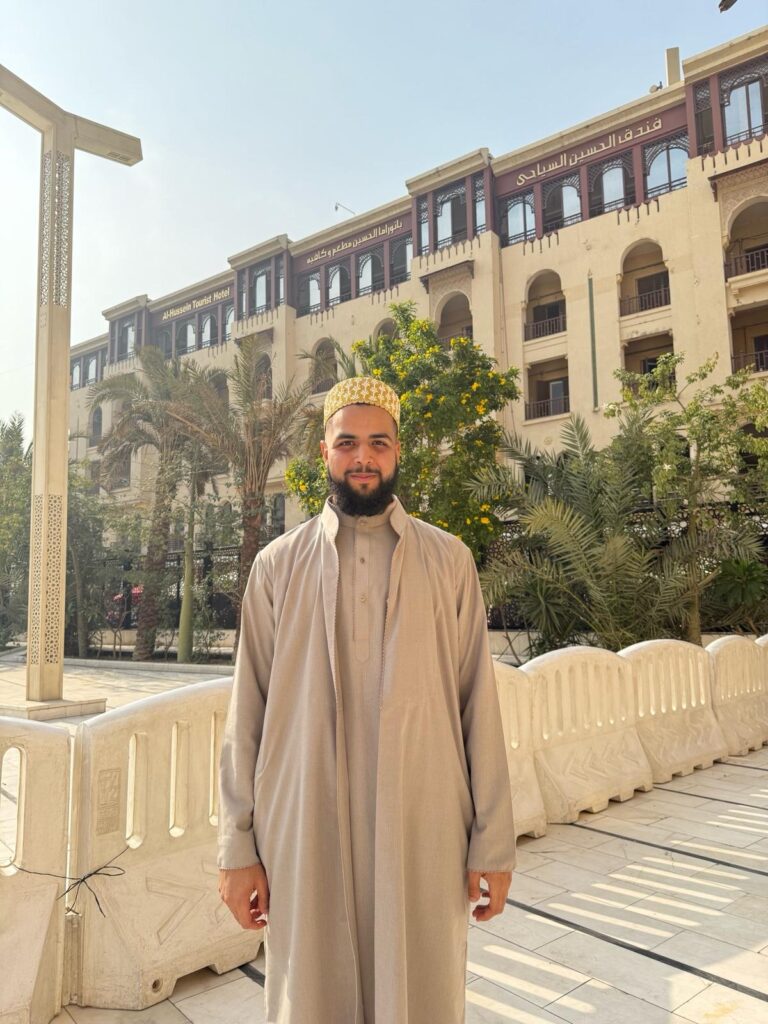
By: Abde Syedna (TUS) Hussain Cutlerywala
The Early Journey
From a very young age, I was fascinated by the idea that a human being could memorize six hundred pages of a book. My young, playful mind could not comprehend it.
At the age of nine, I experienced my first small taste of this journey when I completed memorizing Juz Amma, the 30th chapter of the Holy Qur’an. Filled with excitement, I rushed to my parents to share the news. My mother, with a warm smile, said, “Okay, now just 29 more Siparah (chapters) to go.”
I laughed, as her words struck me as comical. I vividly remember looking at the thickness of the Qur’an and smirking, holding it at different angles, and hoping it would look less intimidating. Becoming Hafiz wasn’t just an impossible feat in my young mind; it was a concept so distant that it didn’t seem real. I shrugged it off, retreating to my room to play on my Nintendo Gameboy. Memorizing the entire Qur’an? That was for extraordinary people, not me.
This mentality lingered through my high school years. Though I memorized bits and pieces, here and there, I never fully committed. By the time I had memorized five more chapters, I felt I had hit a wall. One day, I turned to my Muhaffiz (teacher) and announced, “I’ve reached my limit. As I start university, I won’t have time to continue my Hifz.”
And just like that, I stopped. No second thoughts, no internal debate. I worried that the mental load would be too heavy – that I would fall behind and fall short in my Hifz, academics, and business pursuits. That pause stayed with me for 2 years – not because I lacked ability, but because I underestimated what discipline, structure, and sincerity could achieve.
For many Mumineen around the world with Hifz aspirations, there is an unspoken fear that quietly shapes our decisions: If I pursue Hifz seriously, something else in my life will have to suffer.
That “something” is usually our secular education, career ambitions, or professional growth. University deadlines, long commutes, demanding jobs, and family responsibilities often make Hifz feel like a luxury reserved for another stage of life, or another type of person.
When I eventually returned to Hifz, my circumstances had not become easier. In fact, life was busier. I was navigating university, my new business venture, responsibilities, and the very distractions that make modern life exhausting. Yet this time, something was different: my mindset.
I stopped viewing Hifz as something that competes with my worldly goals. Instead, I treated it as something that trains me for them.
Nairobi Ashara 2021
I remember every aspect of Nairobi Ashara 2021 as clear as day. The extended quarantine requirements before Ashara, the COVID-19 testing, and the struggle to secure accommodation all made the journey challenging. Despite these obstacles, I was fortunate to attend after a generous family graciously agreed to host me for twenty days, a blessing I did not take lightly. This Ashara took place roughly a year and a half after I had stopped my Hifz journey.
One waʿaz in particular left a deep impression on me, as it placed strong emphasis on Hifz-ul-Qur’an. In it, Aqa Moula TUS spoke about the level of Hifz being achieved in our community today. He mentioned that often, when Mumineen come for nikah, young men/women will do araz saying, “Moula, hafiz chhu.” And when Moula TUS then asks, “Jamea na chho?” they reply, “Nahi Moula, ghar si kidu chhe.” I vividly remember the smile on Aqa Moula TUS’s face as he said, “600 page Hifz karvu itnu mushkil, lekin muhabbat na sabab Mumineen kare chhe.”
In that moment, I was forced to internally confront my own assumptions. For the past year and a half, I had convinced myself that Hifz was only possible under ideal circumstances—through formal institutions, with abundant resources and structure. Yet here was Aqa Moula TUS himself affirming that Mumineen were memorizing the Qur’an from their homes and becoming Huffaz purely out of muhabbat. Although those words struck me deeply and planted the seed to return to Hifz, I did not take the step to begin again until April 2022.
How We Use Our Time:
The first and second years of university were pivotal in my life. I was fully immersed in my studies and career aspirations, determined to give my absolute best. With no other major commitments, my focus was singular, but I was constantly analyzing how my time was being spent each week. Despite my efforts to maximize productivity, I couldn’t ignore the large chunks of time consumed by social media and phone addiction. A quick click on Instagram or TikTok could easily spiral into a 1-2 hour time drain.
During this period, I also became acutely aware of how much time I spent driving. The quick math was startling:
● Drive to University: 40 minutes
● Drive back from University: 40 minutes
● Total (per day): 80 minutes
● 4 times per week: 320 minutes (~5.5 hours per week)
And that was just for university! When I factored in trips to the gym, sports games, meetings, and social events, the total driving time often exceeded 8 hours per week.
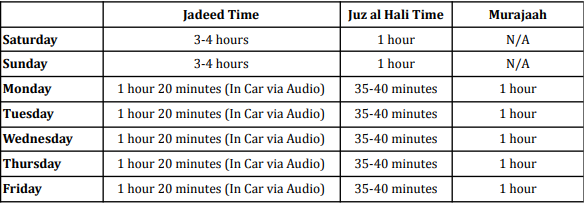
This realization sparked an idea: if I could dedicate those 8 hours of driving to memorizing just four Jadeed (new) pages of the Qur’an, I could complete 18-20 pages of Jadeed Hifz every month. The only additional effort required would be to allocate an extra hour each day for Murajaah (revision) and Juz Hali. This meant that the total extra time spent daily would only be about 1 to 1.5 hours – a manageable commitment.
The idea made sense in theory, but I quickly realized that I couldn’t rely solely on listening to the Qur’an to memorize it. I needed a foundational familiarity with each page before using audio to refine and perfect it. As I reevaluated my schedule, I noticed that my weekends were vastly underutilized. By dedicating my Saturdays and Sundays to memorizing my Jadeed (new) pages, I could lay the groundwork. Then, during the weekdays, I could focus on perfecting those Jadeed pages through consistent practice and repetition. I thought the idea made perfect sense, because on the weekends I would only go out to social events past 4 PM anyway so my mornings were always free.
Application
In April 2022, I made the firm decision to start my Hifz journey again. I resolved to move forward without hesitation, determined to live a life without regrets. I also made a promise to myself: no matter what challenges arose in my personal life, I would not let anything derail me from my Hifz journey. I held unwavering faith that the barakat (blessings) of Hifz-ul-Qur’an would guide me and help resolve any problems that came my way.
Here was my targeted schedule from April 2022 to September 2024. (29 months):
It is important to note that this approach worked for me personally. Everyone has a different learning style, pace, and capacity. On average, I spent a total of about 1.5 hours per jadeed page before class; some may complete it faster, while others may need more time. We are all different, and that is perfectly okay!
Targets
● 4-5 Pages Jadeed Hifz Every Week With Less Than 1 Talqeen
● 30-40 Pages Juz al Hali Every Day
● 1 – 2 Siparah Murajaah every weekday with focus
● Weekends would aim to do 1 Siparah Murajaah but many weekends were solely focused on Jadeed
● After reaching the 20th Siparah weekend Murajaah became mandatory as well, and it had to be 2 siparahs Murajaah daily
● No compromise on physical health (Making sports and exercise a priority)
Clarifying Notes:
● For audio memorization during weekdays, I would listen to each ayat on a 25x repeat at 2x speed during my commute to and from university, totaling 50 repetitions each day. (One of my mentors in the past had mentioned that 50 is the golden number of repetitions needed to get a grasp on the structure of an ayat.)
● If the page was already strong, I would sometimes replace one set of repetitions with a weaker siparah for Murajaah (revision).
● If my weekends were compromised due to another commitment, I would try to adjust my Jadeed throughout the week and aim for only 3 pages rather than 4 or 5
● I would have a Muhaffiz to listen to each new page of Jadeed I did throughout the week
Closing Stages:
I completed the memorization of all 600 pages of the Qur’an in September 2024. The final step remaining was perfecting my memorization to pass the ikhtebaar (exam) conducted by Mahad Al Zahra. For 1.5 months, I maintained a simple schedule of revising three siparahs per day, as there was uncertainty about when I would be able to take my final ikhtebaars.
In November 2024, I connected with Mahad Al Zahra in Houston to help me prepare for my final ikhtebaars. They provided invaluable advice that played a pivotal role in helping me achieve my goal:
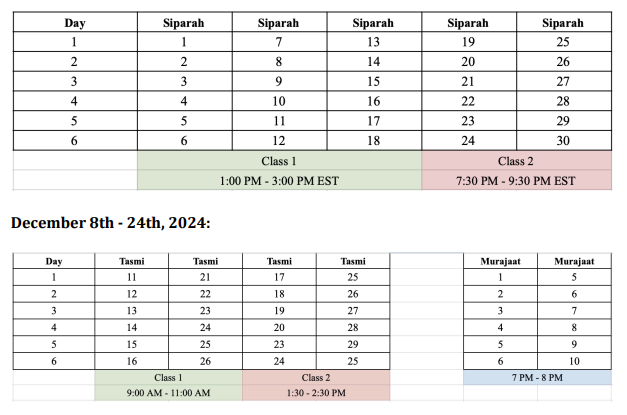
4-5 Siparah Tasmi (Recitation) Every Day
Daily recitation of 4-5 siparahs to strengthen fluency and retention.
Daily Tasmi Class
Each class included two random questions from each siparah, simulating the format of the final ikhtebaar.
Focused Murajaah
For any siparah identified as weak, I committed to targeted Murajaah (revision) before each Tasmi class to improve my performance.
Following this structured approach, I successfully passed my Taqdeem and Nihai ikhtebaar on December 24, 2024.
Here are some sample schedules from my final month of Hifz-ul-Qur’an preparation:
November 19th – December 5th, 2024:
Final Notes:
The decision to memorize the Qur’an is not without its challenges. Along the Hifz journey, you will face hardships, but with true faith and unwavering determination, you can overcome them. For me, the keys to Hifz-ul-Qur’an lie in discipline and faith.
The mindset I adopted was simple yet powerful: no matter how demanding my schedule became, I would prioritize my Hifz for the day. And no matter what challenges arose, I would face them with the conviction that I could persevere through the dua mubarak of Syedna Mufaddal Saifuddin TUS.
Hifz strengthened my focus in a world of constant distraction. It taught me resilience when revision felt overwhelming and humility when mistakes resurfaced. It trained my mind to work deeply, patiently, and with intention – qualities that directly translated into better performance in school and in business.
For those who fear that Hifz will slow them down, I offer this reflection: Hifz does not take away from your ambitions. It refines them. It grounds you in something eternal while you navigate something temporary. It reminds you, daily, why discipline, patience, and sincerity matter.
If you are standing at the crossroads of career goals and Hifz aspirations, know that the path forward is not about perfection or speed; it is about commitment, structure, and faith. Through all of life’s hardships, the Qur’an will be the steady anchor that is always there for you. I might even say, a friend?
My Hifz journey came to an end at the end of 2024, a transformative experience that shaped me for the better in every way. And I have to admit now that I actually miss it. Who would have thought? 🙂